
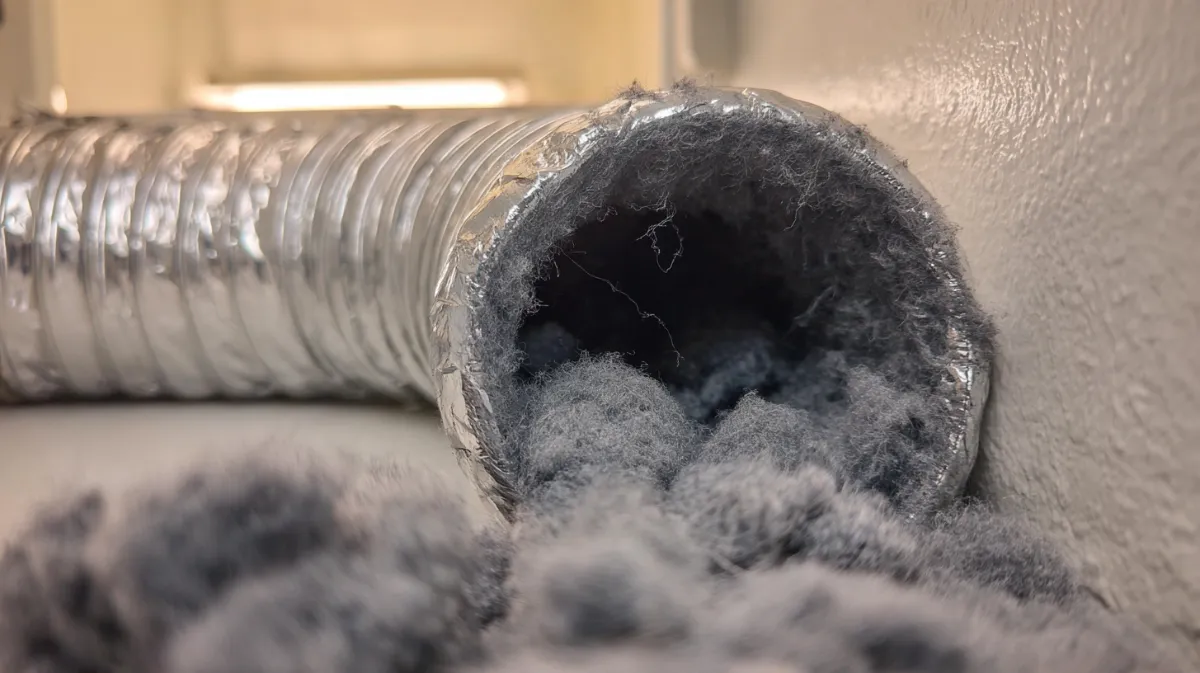
Jeans come out damp after a full cycle. You run it again. The laundry room is warm and smells a little like hot dust, and there's a film of lint on the shelf above the machine. Most people blame the dryer and start shopping for a new one. Usually the dryer is fine. It makes heat and moves air, and when the pipe that carries that air outdoors is packed with lint, the moisture has nowhere to go. We see it all over Rohnert Park, where many townhomes and condos have the laundry in an interior closet. It's just as common in Windsor's two-story homes, where the laundry is upstairs and the vent climbs to the roof.
This page explains how to check the vent yourself, what California's code says about vent length, what our cleaning involves and how often it needs doing. If the dusty smell is coming from the heating vents too, have a look at our air duct cleaning.
A Two-Minute Check You Can Do
Start a load and walk outside. Find where the vent comes out. It's usually a small hood with a flap, low on a wall or up on the roof. On a wall hood, the flap should be standing open with warm air you can feel from a foot away. Weak air, or a flap that barely moves, means a blockage. Next, look behind the dryer. The short hose that links it to the wall should be metal and should not be flattened against the wall. Last, think about time. When an ordinary load won't dry in one cycle, or the dryer's cabinet is hot to the touch, the vent needs cleaning.
The 14-Foot Rule
California's mechanical code limits a home dryer vent to 14 feet in total, and that figure already assumes two 90-degree bends. Each extra bend takes two feet off the allowance, unless the dryer's maker says the machine can handle more. The reason is simple. A dryer's fan is small, and every foot of pipe and every turn slows the air. Slow air drops its lint. Plenty of local laundry rooms were built or moved without much thought for that limit, and their vents run 20 or 30 feet through a ceiling. Those can still work. They just need cleaning more often, and in some cases a booster fan. The code also calls for smooth metal pipe inside the walls. Plastic or foil hose in there is a hazard.
Our Cleaning, Step by Step
We slide the dryer forward and unhook it. A brush on a set of flexible rods goes into the vent and spins its way to the far end while a vacuum catches the lint at the opening. For roof vents and second-floor exits, we also work from the outside so the cap gets cleared. Bird and wasp nests come out. The flap or damper is checked so it swings freely and closes when the dryer stops. Back inside, we vacuum the cavity under the lint screen and the floor behind the machine. A crushed or plastic connector hose gets replaced with a proper metal one. Then we hook everything up, run the dryer and take an airflow reading at the exit.
How Often It Needs Doing
For an average family, once a year. Fire safety agencies give the same advice, and it matches what we find in the field. Some households should go to twice a year: big families, anyone washing pet bedding regularly, and any home whose vent goes up through the roof. A couple whose dryer backs onto an exterior wall can often wait two years. Between visits, pull the lint screen after every load. Wash it with dish soap every few months, because fabric softener leaves a coating that air can't pass through. And glance at the outside flap now and then while the dryer is running.
Lint builds up in the furnace as well, especially when the laundry shares a closet with it, and our HVAC system cleaning deals with that side.
Frequently Asked Questions
No. The vent has to end outdoors. A dryer pushes out all the water it pulls from a load of wet clothes, plus lint, and a gas dryer adds exhaust from its burner. Dumping that into a garage or crawl space leads to mold, a lint-covered space and, with gas, a carbon monoxide risk. If yours ends short of the outside, we can show you where it stops and what it would take to fix.
It works, but it's the hardest kind to keep clear. The air has to push lint straight up, so more of it falls back and collects at the bottom of the rise. Roof caps also clog at the screen or damper, where no one can see it from the ground. Plan on a cleaning every year for a roof vent, or every six months with heavy use.
A little around the hood is normal. A lot of it, or lint stuck to the siding, usually means the flap is jammed open or the screen is clogged and air is being forced out around the edges. It can also mean birds have been pulling at a nest inside. Either way, the vent isn't breathing right and should be looked at soon.